
Sieve Retention
There are a number of retention mechanisms employed by depth filters. Among them are: sieving, inertial impaction, Brownian motion, and adsorption.
Sieving is the simplest form of particle retention, and results from the removal of particles that are larger than the pores that they are trying to pass through. . The retention is independent of the numbers of particles or pores, and it is independent of the filtration conditions. For example, unless it is high enough to deform the suspended particles, differential pressure does not affect the particle removal. The nature of the filter and also that of the particle, is of no concern unless the physical chemistry of the fluid reducers the particle size or enlarges the pore size.
The particle may be large enough to be retained at a pore entrance or it may become trapped at a restrictions within the pore. If the particles is deformable, the differential pressure increases it may become further embedded in the fiber matrix. It is conceivable that if a differential pressure gets high enough the particle could be forced through the pore restrictions, deeper into the matrix, and possibly through the matrix back into the fluid stream. Therefore, it is very important to adhere to the pressure limitations as provided by the filter media manufacturer. There are practical limits to the thickness of the filter sheet. The thickness of the filter medium plays an important role in its particulate holding capacity.
Inertial Impaction
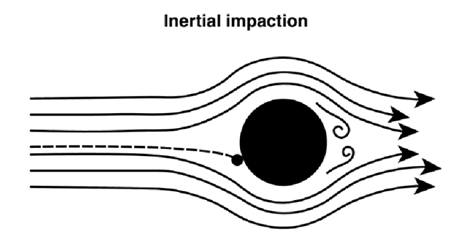
The initial impaction of a particle upon a filter sulface can occur when the fluid bearing the particles changes his direction of flow as it is deflected into and through the filter pores. The inertial of the particle may continue on its original path to collide with the filter surface where absorptive forces can cause it arrest.
This inertia force depends directly upon the mass of the particle, and the square of its velocity. It is, therefore, more important with heavier particles. The inertial force is attenuated by the viscosity of the fluid and is consequently influenced by temperature that is inversely related to velocity.
Brownian Motion
Smaller particles, less heavy, are less influenced by inertial. However, they are more affected by Brownian motion wherein they are vectored from the fluid pathway to the pore surface by collisions with the fluid’s molecule. The result is retention of the particles by the filters surfaces them impact.
At all temperature above absolute zero the various sections of all molecules are in constant motion: the various bonds being flexed, rotated, stretched, etc. The higher the temperature, the greater the amplitude of the molecular motion. The significance of absolute zero is that only at that temperature or below is all molecular movement frozen. In their frenetic activity, the fluid molecules collide, perhaps repeatedly, with suspended particles. The latter are directed to new directions of travel within the fluid stream. As a result of their induced random and erratic movements, the particles have opportunities to encounter pore surfaces. This is the nature of Brownian or diffusional interceptions. It is favored by small size particles, and by the lower viscosity’s of the suspending fluid.