
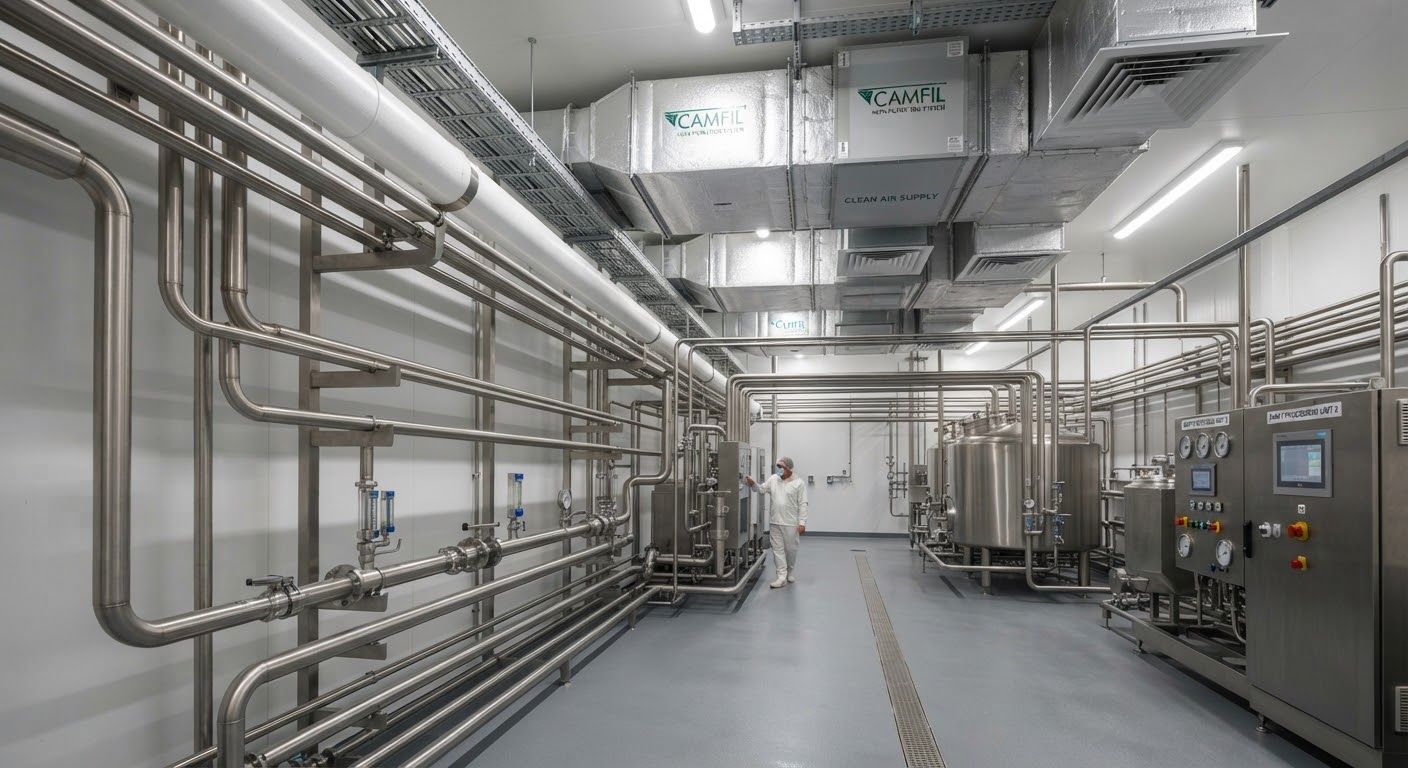
When we think about dairy food safety, our minds usually go straight to pasteurization, stainless steel tanks, and rigorous sanitation shifts. Yet, according to FDA recall data from 2010–2013, 66% of all dairy-related recalls were caused by environmental pathogen contamination.
Pathogens like Listeria monocytogenes, Salmonella, and Cronobacter sakazakii don’t just appear out of nowhere—they travel and thrive through poorly managed plant utilities. Air, water, steam, and compressed air interact directly and indirectly with finished products every single minute of production.
Drawing from the Innovation Center for U.S. Dairy’s guidance, Controlling Pathogens in Dairy Processing Environments, as well as 3-A Sanitary Standards and the Pasteurized Milk Ordinance (PMO), here is how modern dairy plants can engineer their filtration and utility systems to keep pathogens at bay.
1. Mastering the Air: HVAC, Positive Pressure, and 3-Stage Filtration
Airflow is one of the most critical—and invisible—vectors for cross-contamination. If air moves from raw milk receiving toward a packaging room, it carries dust, aerosols, and microbes with it.
The Golden Rule of Airflow
Air must always flow from the most sensitive areas to the least sensitive areas:
High Hygiene (Zone 1) → Ready-to-Eat / RTE (Zone 2) → Raw / Basic GMP (Zone 3) → General / Non-Manufacturing (Zone 4)
To achieve this, facilities use positive air over-pressure in clean rooms:
- Pressure Differentials: Maintain a pressure gradient of 0.03 to 0.05 inches of water between clean and less-clean rooms (or roughly 0.1 inch / 15 Pa as a general HVAC guideline) during both production and sanitation.
- Air Exchanges: While a minimum of 7 to 10 air exchanges per hour is recommended generally, the FDA specifies 20 to 25 air exchanges per hour in High Hygiene areas.
- Temperature & Humidity: In high-hygiene zones, keeping temperatures below 78°F (26°C) and relative humidity below 35% RH helps control moisture and prevents fugitive dust from adhering to structures.
The 3-Stage Filtration Standard
Critical and high-hygiene rooms should use forced ventilation with laminar flow through a 3-stage filtration system capable of up to 99.999% filtering efficiency:
- Stage 1 – Coarse (Pre-Filter Class): MERV 1–8 (EU G1–G4) to capture gross particles (>3–10 μm). Used alone only in dry storage areas.
- Stage 2 – Fine (Medium Class): MERV 9–15 (EU F5–F9) to capture particles between 0.3 and 3.0 μm. MERV 14 is often sufficient where products are enclosed or hot-processed.
- Stage 3 – Clean Room Filtration (HEPA / ULPA):
- HEPA (MERV 16–20 / EU H10–H14): Captures particles >0.3 μm. Essential for exposed RTE products and mold-sensitive cheeses.
- ULPA (U15–U17): Captures particles >0.12 μm for super-clean rooms.
Pro Tip: In the most critical areas, installing UV lights downstream of HEPA filtration provides an extra layer of microbial defense. Additionally, design HVAC units so that maintenance access is located outside controlled production zones, and ensure all drip pans and dehumidifiers are piped directly to a drain.
2. Compressed Air: The Hidden Product Ingredient
Is compressed air touching your product? If your facility uses line air-blows, incorporates air into ice cream (overrun), uses baghouse pulsing systems, or relies on pneumatic airlock seals, your compressed air is effectively a food-contact surface.
To meet PMO and 3-A standards, product-contact compressed air requires:
- Upstream Oil & Water Removal: A dedicated filtration/elimination system must sit upstream of final filters, ideally drying the air to a dew point of -40°F to prevent moisture in the lines.
- Point-of-Use HEPA & Sterile Filtration: Inline point-of-use filters must remove particulates down to 0.01 μm at ≥99.99% DOP efficiency, and microbial contamination down to 0.01 μm at ≥99.9999% DOP efficiency.
- Strict Floor Discipline: Never use compressed air drops in filling rooms or around exposed product during production. Blasting air near floors or equipment legs aerosolizes lurking pathogens and launches them onto food-contact conveyors and vessels.
3. Water & Steam Utilities: Preventing Backflow and Cross-Contamination
Water is essential for cleaning and processing, but uncontrolled water is the #1 catalyst for pathogen growth.
- Potable Water & Backflow Prevention: Main backflow preventers must be inspected and documented annually. At the point of use (such as CIP skids, sinks, and COP tanks), install backflow prevention devices or maintain a physical air gap of at least 2X the diameter of the water supply inlet.
- Point-of-Use Water Filtration: Whenever water is added as an ingredient or used as a direct-contact rinse, it must pass through point-of-use filters. Furthermore, water contacting Grade A pasteurized products or finished product contact surfaces (outside of CIP) must meet PMO “pasteurized equivalent” standards.
- Cooling Water & “COW” Water: Recirculated cooling water (and glycol/salt systems using USP food-grade or GRAS depressants) should be microbiologically tested at least semi-annually. If your plant reclaims Condensate of Whey (COW water) from evaporators or membranes for cooling, you must maintain strict pressure differentials—keeping the product side at a higher pressure than the cooling water side at all times.
- Culinary Steam: Boiler water-hardness treatment chemicals for culinary steam must comply with 21 CFR 173.310.
4. Special Focus: Dry Dairy & Powder Operations (“Dry Needs to Stay Dry”)
In spray drying and powder packaging operations, dairy powders are hygroscopic—meaning they eagerly absorb moisture from the air, turning harmless dust into a nutrient-rich breeding ground for Salmonella and Cronobacter.
Controlling utilities in a dry plant requires specialized engineering:
- SCADA-Integrated Air Balancing: Spray dryers, fluid beds, and pneumatic conveyors consume massive volumes of internal building air (often creating a 7,200+ CFM difference between operating and non-operating states). Linking the dryer and building HVAC via the plant’s SCADA system automatically balances makeup air and prevents sudden pressure swings.
- Zero Condensation Tolerance: Dryer buildings typically run hot and dry (110°F and <35% RH). Never aim HVAC louvers directly at dryer chambers, fluid beds, or baghouses—cooling the outside wall of a vessel can drop the internal surface below the dew point, causing interior condensation and wet powder clumping. Similarly, explosion vents must be heated to prevent cold spots.
- Quick-Disconnect Hose Stations: Because water should be restricted in dry zones, equip necessary wash-down stations with main shut-off valves and quick-disconnect fittings. Remove hoses completely during normal production runs so personnel aren’t tempted to spray water, and rely on dedicated, zone-specific HEPA-filtered vacuums (stored in 130°F+ “hot-boxes”) for routine cleaning.
- Sanitary Utility Routing: Keep electrical, air, and vacuum lines separated (not bundled) or enclosed in smooth conduit at least 12 inches off the floor, and never route horizontal piping above open product.
The Takeaway: Utilities Are Part of Your Food Safety Equation
Pathogen control isn’t a single step; it’s an integrated equation combining Hygienic Zoning + GMPs + Sanitary Design + Effective Sanitation + Environmental Monitoring. By mapping your airflows, upgrading to 3-stage HEPA filtration, securing your water backflow gaps, and validating your compressed air purity, you transform your plant’s utilities from a hidden vulnerability into your strongest line of defense.